
TransLink| BUS 741 Indigenous Business Environment | SFU Masters In Business Administration
Power Point Presentation
Technical Information
Tools Used:
Date:
Client:
Indigenous Business Environments | SFU MBA
Introduction
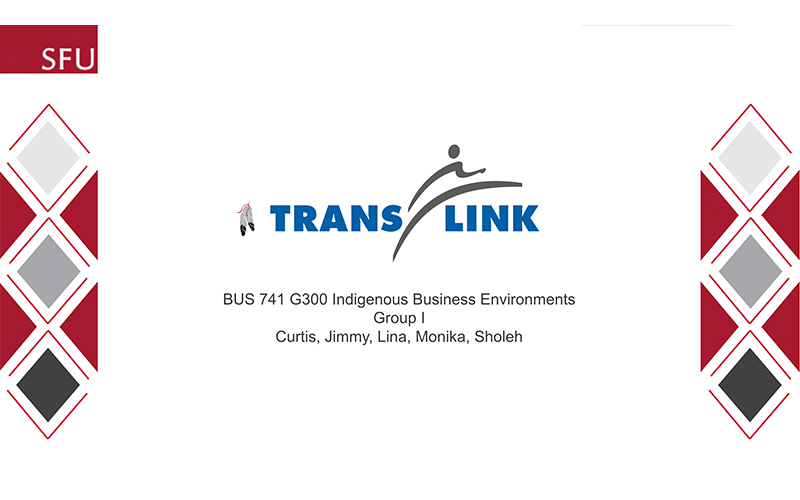
This presentation was created for my SFU Indigenous Business Environments course in my Masters of Business Administration. I helped add in some of the content and also designed the entire powerpoint.
Process
Creating a Base Template
This PowerPoint has graphic elements added from Illustrator and Photoshop.
Slide 2: Table of Contents
Slide 3: Land Acknowledgement
Simon Fraser University respectfully acknowledges the unceded traditional territories including, Sḵwx̱wú7mesh Úxwumixw (Squamish), səlilwətaɬ (Tsleil-Waututh), and xʷməθkʷəy̓əm (Musqueam), Nations, on which SFU Vancouver is located.
Slide 4: Purpose
Why Now
Decision
Outcome
Slide 5: TransLink’s Historical Journey with Indigenous Relations
| Project/Era | Legal Framework | Relationship Model | FPIC Standard Met? |
|---|---|---|---|
| Expo Line 1986 | Pre-consultation duty | Build first/overlooked | No |
| Canada Line 2009 | Duty to consult (post-haida) | Consultation (often strained) |
No |
| Evergreen 2016 | Duty to consult & Accommodate | Provincial-Kwikwetlem agreement & cultural integration (Moving toward FPIC) | Moving towards it |
| Broadway Surrey-Langley (2020+) | DRIPA/UNDRIP (FPIC) | Government-to-Government Co-development & consent agreements (provincially delivered; TransLink provides integration services) | Yes, this is the new standard |
Slide 6: The Imperative for Reconciliation – Lessons from History
Legal & Business Survival:
The law now demands consent (DRIPA/UNDRIP), not just consultation. Early partnership is the only viable path to on-time, on-budget projects.
Social License Imperative:
Trust is TransLink’s core asset. It’s earned through consistent, long-term partnership, not assumed.
Moral Responsibility:
History reveals an unfinished duty to move from transactional engagement to a permanent, respectful partnership.
Slide 7: Current Planning Approach and Indigenous Engagement
The process:
The Core Issue: Indigenous Nations are engaged as stakeholders, not as rights-holding governments, after key decisions are made.
The Consequence: Indigenous Nations are engaged as stakeholders, not as rights-holding governments, after key decisions are made.
Slide 8: Assessment of Current Commitments & Gaps
Progress (Project-Based)
Critical Gaps (Systemic)
The Result: Progress is inconsistent and reactive, creating ongoing risk.
Slide 9: Indigenous Rights-Holders & Non-Market Risk Analysis
Rights-Holders ≠ Stakeholders
The Cost of “Government-First” Risk
The Opportunity of “Rights-Holder-First”
Strategic Implication: Embedding FPIC isn’t just ethical—it’s essential risk management.
Slide 10: Recommended Actions & Co-Development Process
- 1
Rights-Holder-First Planning
- Engage Indigenous Nations as first partners, not last stakeholders.
- 2
Permanent GovernancePermanent Governance
- Create Board-level Indigenous Advisory Council.
- Appoint VP of Indigenous Relations.
- 3
Actionable Commitments
- Aligned with TRC Calls #57 and #92: Set targets: 5% procurement, 7% workforce from Indigenous communities. Mandate cultural competency training for all staff (Call #57). Adopt UNDRIP as a reconciliation framework (Call #92).
- 4
Measurable Accountability
- Public annual reports with clear metrics.
- Tie executive compensation to outcomes.
Slide 11: Conclusion & Vision
The Lesson: Partnership > Consultation.
The Path: A formal Reconciliation Action Plan (RAP).
The Vision: Transit that moves people and reconciliation forward.
Solution
Overall It was a 15 minute recorded presentation.