
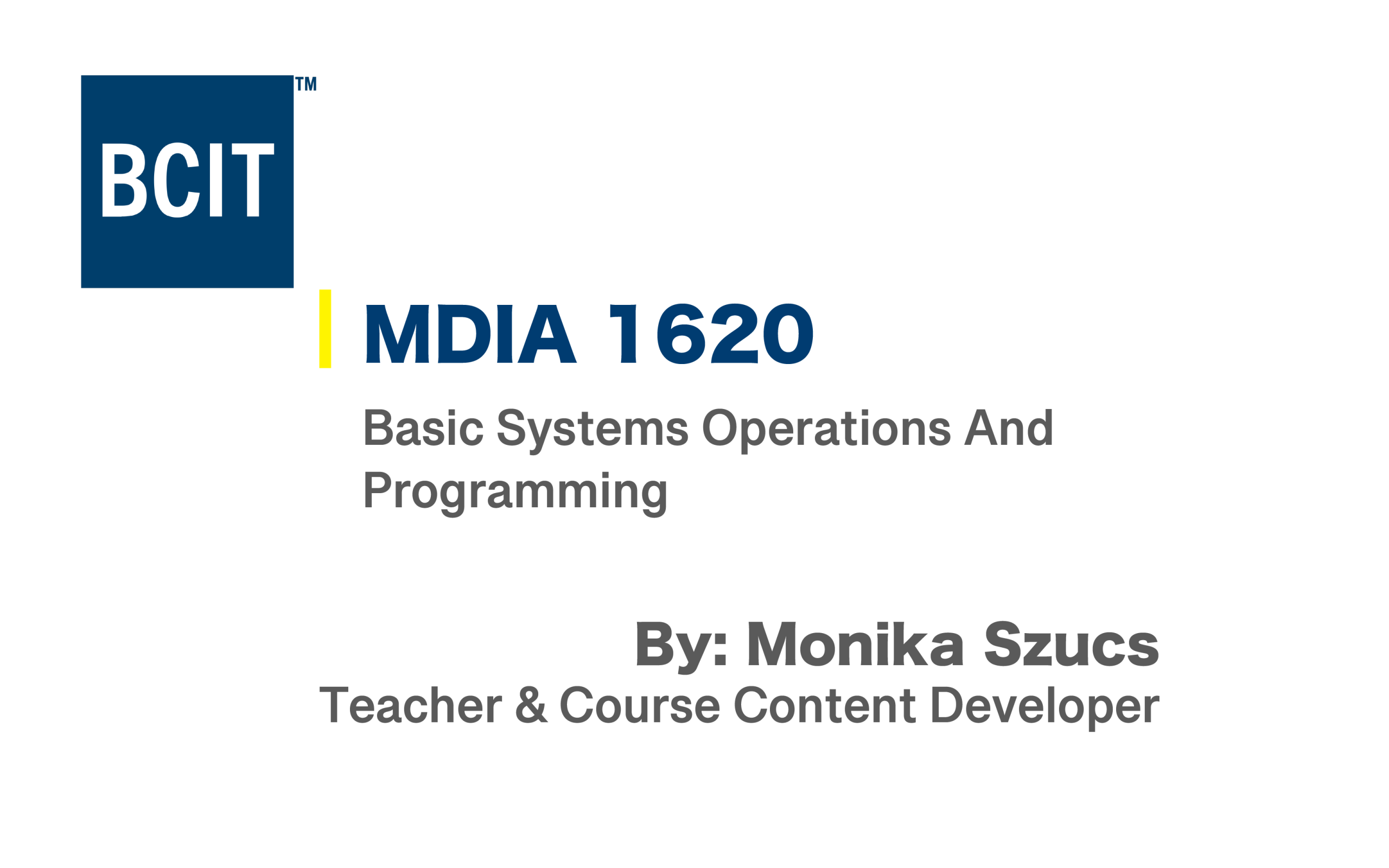
MDIA 1620 Basic Systems Operations and Programming
BCIT
Technical Information
Software Used:
Date:
Client:
Henry Leung BCIT
Title:
Curriculum Developer
Course Description
Monika Szucs help created and update the content in the Digital Design and Development Diploma at BCIT.
Students in this course will receive an in-depth exploration of the current technological system operations and programming methodologies and scripts to operate, manage, and install application protocols and plugins effectively. Through a combination of lectures and hands-on exercises, students in this course will be provided with practical real-world experience. Students will create scripts and commands to operate a computer system to do administrative work such as accounts, securities, and system modifications. Students will learn to connect with other operating systems such as repositories and servers. Student will learn basic programming foundation to operate and connect system communications and become an effective troubleshooter and collaborator.
Course Learning Outcomes/Competencies
Upon successful completion of this course, the student will be able to:
Course Goals
The goal of this course is to get students comfortable with using the command lines to navigate around the computer, setting up their coding environment, and understanding coding terminologies. With this in mind, this course sets up the foundations of coding which will allow students to apply these fundamentals in their future coding classes.
Evaluation Criteria
| Criteria | % |
| In Class Exercises | 30 |
| Midterm Exam | 35 |
| Final Exam | 35 |
Course Schedule and Assignments
| Week # | Week of | Content | Note |
|---|---|---|---|
| 1 | Sept 3 | Labour Day
Introduction to file/folder structures, node.js and javascript. |
|
| 2 | Sept 10 | Basic setup operations of javascript with command lines and formatting. | Exercise |
| 3 | Sept 17 | Introduction to basic hierarchy structures, string formatting and arithmetics. | Exercise |
| 4 | Sept 24 | Introduction to variable calculations and identifying data types. | Exercise |
| 5 | Oct 1 | National Day of Truth and Reconciliation
Operators and statements. |
|
| 6 | Oct 8 | Thanksgiving Day
Introduction to Functions |
|
| 7 | Oct 15 | Variations of Functions | Exercises |
| 8 | Oct 22 | Midterm | |
| 9 | Oct 29 | Setting up data and repositories. | Exercises |
| 10 | Nov 5 | Setting up data and looping through information. | Exercises |
| 11 | Nov 12 | Remembrance Day
Setting up loops and operators. |
|
| 12 | Nov 19 | Intro to testing. | Exercises |
| 13 | Nov 26 | Intermediate testing | |
| 14 | Dec 3 | Final Exam |
Course Topics
Design
- Using drawing tools to plan out code and organisation structures.
Test
- Setting up unit tests
Develop
- Setting up the basics of JavaScript code.
Sample Videos
Solution
Creating content to help students learn coding from scratch. This course helped students learn the basics of JavaScript, Next.js, Node.js, GitHub and how to navigate around Visual Studio.